OmniBot V2 - Developer Documentation
Overview
Thank you for your interest in GyroPalm OmniBot. This documentation is your starting point for understanding OmniBot V2, a modern Autonomous Mobile Robot (AMR) designed for real-world facilities, research, and automation workflows. OmniBot V2 comprises the culmination of decades of experience in mechatronics, robotic control, wearables, and industry-standard autonomous algorithms and combines these aspects into a robust, portable, and versatile mobile robot platform.
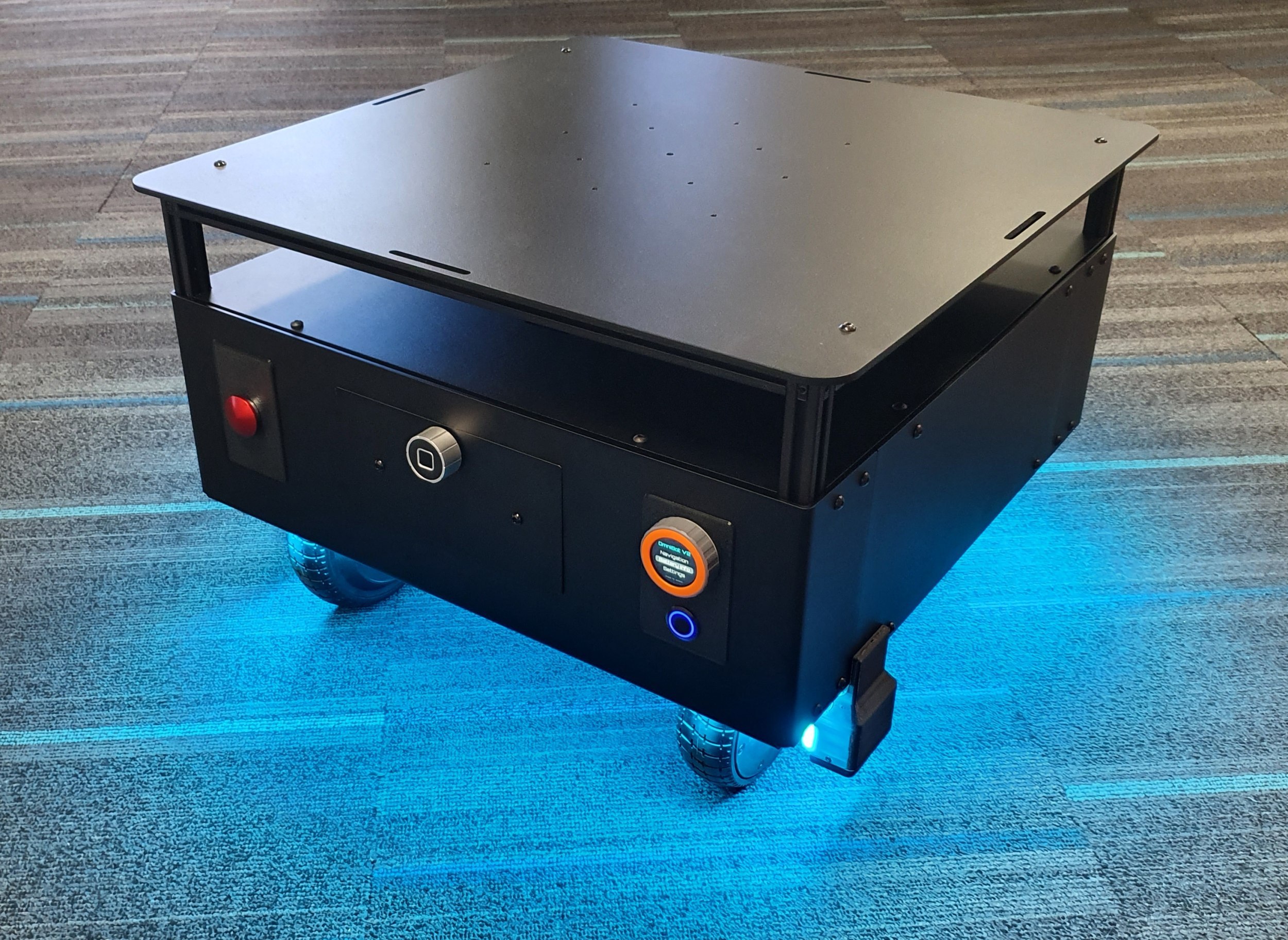
OmniBot V2 is designed for multi-user hands-free teleoperation and autonomous control. With this platform, users can be two places at once, safely move heavy or hazardous materials at a distance, remotely perform security patrols, serve as last-mile indoor package delivery, collect data for building inspections, and more.
You do not need prior robotics experience to use this product. This document is written for engineers, developers, and system integrators who may be new to industrial automation but want a clear mental model of what OmniBot V2 is, what it can do, and why it exists.
What Is an AMR?
An Autonomous Mobile Robot (AMR) is a robot with wheels that can move through an environment on its own, making decisions in real time based on what it senses around itself (i.e. people, walls, obstacles, etc).
Unlike traditional industrial robots that follow fixed tracks or require pre-programmed routes, AMRs:
- Understand their surroundings
- Navigate dynamically
- Can accept commands to new goals without changing code or "tracks"
- Adapt when obstacles or layouts change
- Can create internal maps using SLAM (simultaneous localization and mapping)
AMRs are commonly used in:
- Facilities and warehouse automation
- Material and parcel transport
- Routine security patrolling
- Research and education environments
- Manufacturing/fabrication plants
- Medical facilities
What Makes OmniBot V2 Different?
OmniBot V2 is an AMR, but it is designed to go beyond traditional automation robots. Unlike traditional AMRs, which require users to revolve around its software, OmniBot V2 is designed around human-centered and facility-based principles. In other words, our vision for the OmniBot series is to provide a scalable solution that can enhance human productivity and enable new facility capabilities across one or more locations. Essentially, OmniBot V2 extends the capability of a building to better serve its users.
Instead of being locked into proprietary software or rigid workflows, OmniBot V2 is built as an versatile, extensible platform that offers:
- Industrial capability
- Research flexibility
- Human-centered control
- State of the Art (SOTA) + GyroPalm's cutting-edge gesture control technology
- Autonomous multi-floor elevator navigation using our Kleidoma technology (optional)
Unlike typical AMRs, which weigh over 100+ lbs without payload, requires fixed configurations, and cannot be easily driven in various buildings, the OmniBot V2:
- Can be gesture driven (for SLAM mapping, waypoint training, or last-mile overrides)
- Can be used in Commercial buildings, Research labs, Universities, Hotels, etc.
- Weighs about 57 lbs - about a carry-on suitcase.
- Is transport-friendly and can fit in a standard 4-door sedan vehicle.
- Can lift up to 250 lbs payload.
- Long-duration operation on a single charge.
- Advanced power management and monitoring.
- Includes standard VESA mounts for optionally adding a display, conveyor belt, robot arm, etc.
- Designed to be approachable and very user-friendly.
Inspired by the OmniBot V1 (the original OmniBot telepresence robot), OmniBot V2 combines all the capabilities of an AMR with telepresence, autonomy, docking, and gesture-control capabilities.
Designed for Developers and Real Environments
Many AMRs are either:
- Highly polished but closed systems, or
- Experimental platforms that never leave the lab
- Prohibitively too expensive (e.g. $35k-100k per robot) before maintenance and integration
- Made with cheap plastic for most of the chassis
OmniBot V2 brings extraordinary value. It is:
- Robust and adaptable for real facilities and warehouses
- Welcoming for researchers and developers
- Documented for long-term support and iteration
- Embraces ROS2 standards while combining GyroPalm's patented technology
- Costs a fraction of most AMRs on the market
- Built with industry-grade 5052 and 6063 aluminum alloy
- Designed in California and proudly made in the USA
This makes it ideal for teams who want to build on top of the robot or structure a dynamic workflow, not just operate it.
ROS2 Compatibility (without the barrier)
OmniBot V2 is fully compatible with ROS2, the industry-standard robotics middleware used in research and production robotics worldwide. GyroPalm provides ROS2 Humble packages and examples for the OmniBot V2 in our GitHub repository.
This means:
- You are not locked into proprietary tooling
- You can leverage a massive open-source ecosystem
- Skills learned on OmniBot V2 transfer to other robots
- Long-Term Support (LTS) for Ubuntu and ROS2 through the community
- Nav2 and SLAM Toolbox supported by renowned institutions
Both beginners and experts in ROS2 will appreciate the clarity after experiencing the step-by-step instructions and context this product provides. This documentation is structured to introduce concepts gradually so you can build intuition on the system at your own pace.
The GyroPalm VIMPAACT Ecosystem
OmniBot V2 is part of a larger ecosystem called GyroPalm VIMPAACT — a human-first approach to robotics interaction.
Through optional wearable and AR integration, the robot can:
- Be driven using intuitive hand gestures
- Be trained interactively in new spaces
- Support remote operation and telepresence
- Enable safer and more natural human–robot interaction
This ecosystem is designed to reduce friction between people and robots, especially in environments where traditional interfaces are slow, cumbersome, or unintuitive.
Typical Capabilities at a Glance
Without diving into hardware or software details, OmniBot V2 is designed to support:
- Autonomous navigation in indoor environments
- Dynamic obstacle avoidance
- Auxiliary power for devices onboard (e.g. robot, display, or conveyor belt)
- High payload handling for its size
- Automated docking and recharging
- Manual, remote, or gesture-based control
- Research and custom automation workflows
Detailed specifications, dimensions, and system internals are covered in later sections of this documentation.
Who This Documentation Is For
This documentation is written for:
- Developers new to robotics
- Engineers integrating automation into facilities
- Researchers building custom behaviors
- Educators using AMRs for learning and experimentation
If you’re coming from software, IT, controls, systems engineering, lab administration — you're exactly the audience this platform was built for.
Where to Go Next
- Hardware — Physical overview and system components
- Drivers — How the robot interfaces with its onboard systems
- ROS2 — Understanding autonomy and navigation concepts
- Advanced — Extended capabilities and customization
- API — Programmatic control and integrations
- FAQs — Common questions and operational guidance
OmniBot V2 is designed to scale and our team is committed to help you meet your needs!
Support and Feedback
If you require assistance, technical support, or have feedback regarding GyroPalm OmniBot, please visit https://support.gyropalm.com/. Your inquiry will be answered within 24-48 hours.
For existing GyroPalm users, you can use your GyroPalm account. For all other users, please click Create account and sign in.
Alternately, you may reach out by emailing to info@gyropalm.com. Please include your full name and a detailed description of your issue.